

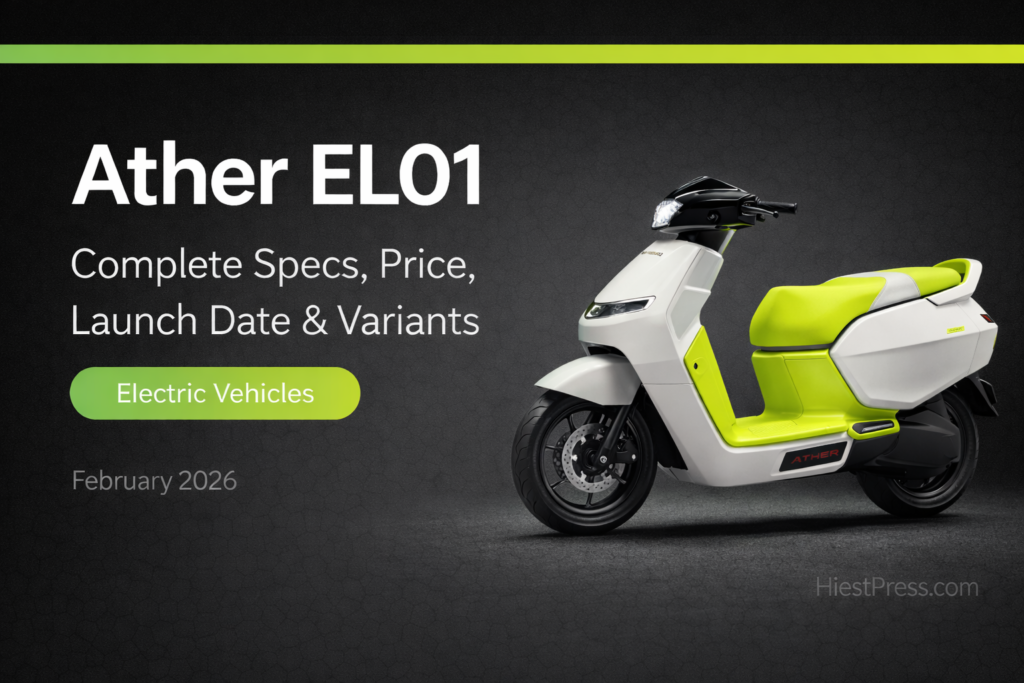
Ather EL01 Review :- Launch date, Price and Features
Ather Energy unveiled the Ather EL01 as a concept at their Community Day event in August 2025. Unlike the 450X or 450S, which are built around performance, the EL01 is designed specifically for practical family use — wider proportions, a comfortable long seat, generous storage, and tech features focused on everyday convenience rather than outright speed.
The scooter runs on Ather’s new EL platform, a clean-sheet architecture built from the ground up for the mass market. This isn’t a stripped-down version of an existing platform — it’s an entirely new foundation designed with scalability in mind, meaning the same base can support multiple future products.
At Community Day 2025, Ather revealed three concept directions built around the EL platform:
- A sporty compact scooter with a 2 kWh battery for performance-oriented younger riders
- A family commuter scooter with a mid-range battery, longer wheelbase, and plush ride quality — this is the EL01
- A maxi-style premium scooter with a 5 kWh battery and 14-inch wheels for longer-range travel
The EL01 is the middle product, and it’s the variant closest to production.
Expected Launch Date
As of February 2026, the Ather EL01 is yet to launch. Ather has confirmed that EL platform-based scooters will be manufactured at their Factory 3.0 facility in Aurangabad (Chhatrapati Sambhajinagar), which is currently being established. In December 2025, Ather also filed a design patent for a scooter closely resembling the EL01 concept — a strong indicator that the production version is well into its final stages.
Different sources are pointing to different windows:
- BikeDekho — June 2026
- BikeWale / EVIndia — April 2026
- EVFY / BikeJunction — Festive season 2026 (October–November)
No official launch date has been confirmed by Ather. Based on available indicators, a launch between April and October 2026 appears most likely.
Price and Variants
The Ather EL01 is widely expected to be priced between ₹99,000 and ₹1.05 lakh (ex-showroom). However, Ather’s leadership has openly indicated that launching below the ₹1 lakh mark isn’t something they’re comfortable with, given their standards for product quality. The more realistic expectation is a starting price at or just above ₹1 lakh once officially announced.
For buyers in Delhi, factoring in GST, registration, and insurance, the on-road price for the base variant is likely to fall in the ₹1.10–1.20 lakh range.
Since the EL platform supports battery packs ranging from 2 kWh to 5 kWh, multiple variants are expected at launch. Here’s a reasonable estimate:
| Variant | Expected Battery | Expected Price (Ex-showroom) |
|---|---|---|
| EL01 STD | ~2.5–3 kWh | ₹99,000–₹1.05 lakh |
| EL01 Long Range (expected) | ~3.5–4 kWh | ₹1.10–1.20 lakh |
| BaaS (Battery as a Service) | Flexible | ~₹90,000–₹95,000 upfront |
Ather has offered a Battery as a Service (BaaS) model on the Rizta and 450 series, where buyers pay a lower upfront price and a monthly subscription for the battery. If extended to the EL01, the entry cost could come down further.
Colors
Ather hasn’t announced production colors for the Ather EL01 yet. The concept shown at Community Day 2025 featured a triple-tone scheme — black on the handlebar cowl, white across the main body panels, and fluorescent green accents on the floorboard, seat, and pillion backrest. This kind of bold combination is typical for concept reveals and will almost certainly change for the production model.
Based on Ather’s color approach with the Rizta and 450 series, the EL01 will likely launch in 3 to 5 colors, with a mix of neutral and vibrant options. Official production colors will be announced closer to launch.
Design and Look
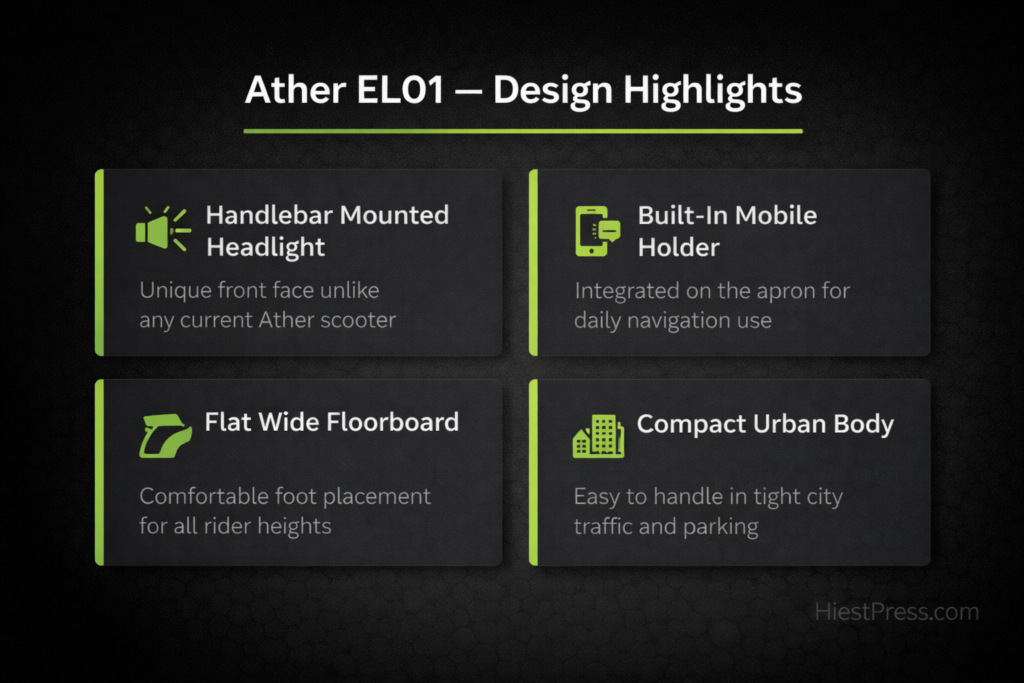
The Ather EL01’s design language is deliberately practical rather than sporty. It has a wider stance, upright ergonomics, and clean panel lines — the kind of design that appeals to daily commuters and family riders rather than enthusiasts.
Front
The headlight with projector lens is mounted on the handlebar cowl, which is different from most scooters in this segment where the headlight typically sits on the front apron. LED DRLs are positioned on the front apron below. The result is a slightly boxy but tidy front face.
Seat and Rear
The seat is a wide single-piece design built for rider and pillion comfort on longer city rides. The pillion grab handle doubles as a small backrest, which is a practical inclusion for city family use. Extendable pillion foot pegs are also present, and the rear carries a clean integrated LED tail lamp.
Storage and Build
One of the Ather EL01’s strongest practical points is storage. With the battery sitting under the floorboard rather than in the boot cavity, Ather claims twin half-face helmet capacity under the seat — which is well above average for this price segment. There’s also a small cubby in the front apron for everyday carry items like a phone or wallet.
The frame is a unibody tubular steel design, where the same structure serves both structural and body functions. This is heavier than the aluminium chassis on the 450 series, but Ather says efficiency isn’t significantly impacted due to other changes in the platform.
Full Specifications
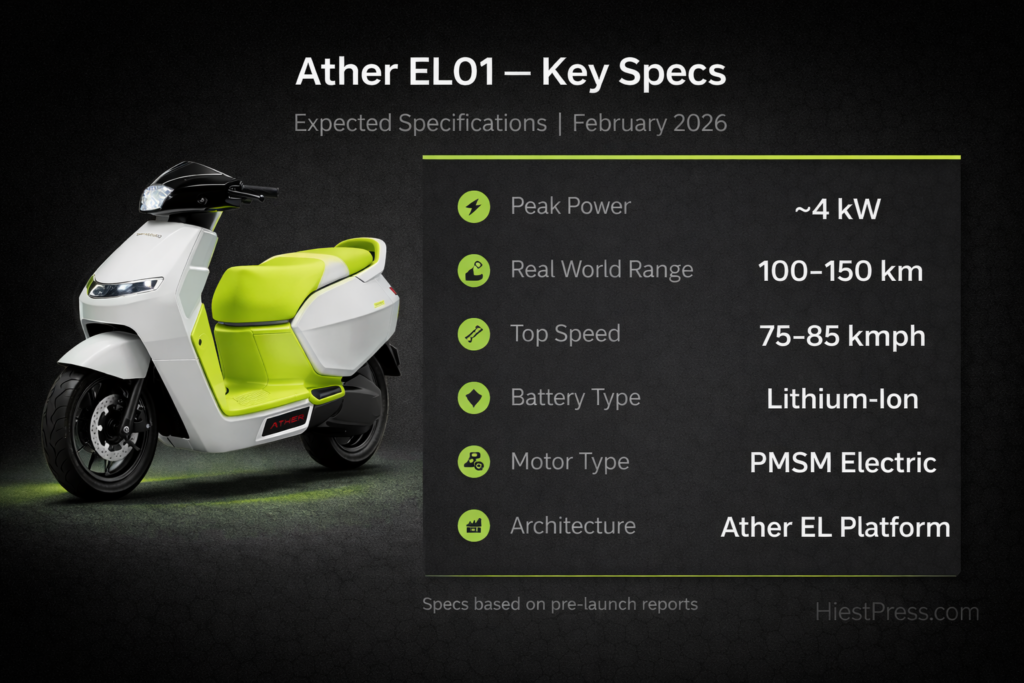
Note: The Ather EL01 hasn’t launched yet. The specifications below are based on official Ather announcements and credible sources. Final figures will be confirmed at launch.
| Specification | Details |
|---|---|
| Motor Type | Swingarm-mounted, gear-driven |
| Motor Power | Not officially confirmed |
| Battery | Li-ion, ~2.5–3 kWh; platform supports 2–5 kWh |
| Expected Range | ~120 km |
| Front Wheel | 14-inch alloy |
| Rear Wheel | 12-inch alloy |
| Tyres | Tubeless |
| Front Brake | Disc |
| Rear Brake | Drum |
| Braking System | AEBS (Advanced Electronic Braking System) |
| Front Suspension | Telescopic fork |
| Rear Suspension | Single shock absorber |
| Frame | Unibody tubular steel |
| Display | 7-inch TFT touchscreen |
| Charging | Integrated AC-DC Charge Drive Controller |
| App Connectivity | Yes (Ather app) |
| OTA Updates | Yes |
| Boot Space | Twin half-face helmet capacity |
| ARAS | Yes |
| Expected Weight | ~110–115 kg |
Features in Detail
Display and Connectivity
The Ather EL01 comes with a 7-inch TFT touchscreen — one of the larger displays available at this price point. It runs an updated version of Ather’s OS and supports smartphone-free navigation, meaning map and route guidance works without requiring a phone connection. OTA (over-the-air) updates allow Ather to push new features and improvements remotely, and the Ather app provides remote access to battery status, trip history, and scooter location.
Voice control is an expected feature on EL platform scooters but hasn’t been confirmed specifically for the base EL01 variant.
Safety
The AEBS (Advanced Electronic Braking System) is one of the platform’s key safety features. It integrates regenerative braking with the disc and drum hardware to shorten stopping distances and prevent rear-wheel lockup under hard braking. Ather has stated that AEBS delivers ABS-equivalent performance, so a traditional ABS unit isn’t required separately.
ARAS (Advanced Rider Assistance System) is Ather’s two-wheeler adaptation of ADAS technology. It provides real-time pothole alerts, crash detection, tow alerts, and obstacle warnings — features that are genuinely relevant to Indian road conditions. Tow and crash alerts also notify the owner through the Ather app.
Riding Features
Multiple riding modes are confirmed for the EL01, with Sport, City, and Eco being the likely options (exact names pending official announcement). Other confirmed or expected convenience features include:
- Reverse mode for easier parking in tight spaces
- Hill-hold assist to prevent rollback on slopes
- Smart cruise control — expected, but not confirmed for the base variant
- Carry hook for bags
- Front storage cubby for small daily-carry items
Charging
The most technically significant charging feature is the Integrated Charge Drive Controller (AC-DC) — a unit that combines the motor controller and onboard battery charger into one. Most electric scooters require a separate portable charger unit. The EL01 doesn’t — you simply plug a cable directly into the scooter, and it manages everything internally. This reduces component count, frees up boot space, and simplifies the charging experience considerably.
Both home wall charging and fast charging via Ather’s charging network are supported.
Service intervals on the EL platform have been extended to 10,000 km, double the 5,000 km standard on older Ather models. Ather attributes this improvement largely to reduced brake wear from the regenerative braking system.
The EL Platform Explained
The EL platform is the engineering core behind the Ather EL01, and understanding it puts the scooter’s capabilities in proper context.
Ather built this platform from scratch, using 26 lakh kilometres of real-world riding data collected from the existing 450 and Rizta fleet. That data informed decisions around what components fail most often, what makes servicing take longer than necessary, and what genuinely frustrates everyday owners.
| Feature | Details |
|---|---|
| Frame | Unibody tubular steel |
| Motor | Swingarm-mounted, gear-driven |
| Battery support | 2 kWh to 5 kWh |
| Wheel sizes | 12-inch to 14-inch |
| Assembly speed | Up to 15% faster than current models |
| Service interval | 10,000 km (doubled from 5,000 km) |
| Service time per visit | ~50% faster |
| Charging | Integrated AC-DC Charge Drive Controller |
| Data foundation | 26 lakh km of real-world Ather fleet data |
| Production plant | Factory 3.0, Chhatrapati Sambhajinagar |
The switch from belt drive to gear drive in the motor is an important one. Belt drives on the 450 series require periodic replacement — a common service item that adds to long-term maintenance costs. The gear-driven system on the EL platform is more durable and eliminates this recurring expense. For a daily-use scooter, that’s a meaningful improvement.
The integrated Charge Drive Controller is equally significant. Combining the motor controller and charger into one unit reduces the number of components, saves space in the underbody (which in turn improves boot capacity), and removes the need for a separate portable charging unit entirely.
Comparison with Rivals
| Feature | Ather EL01 | Bajaj Chetak | TVS iQube | Ola S1 X | Ather Rizta S | Honda Activa e |
|---|---|---|---|---|---|---|
| Price | ~₹1 lakh | ₹1,07,400 | ₹1,11,422 | ₹89,999 | ₹1,09,999+ | ₹1,18,147 |
| Range (claimed) | ~120 km | 127 km | 94 km* | 108 km | 123 km | 102 km |
| Battery | ~2.5–3 kWh | 3 kWh | 2.2 kWh | 2 kWh | 2.9 kWh | 3 kWh |
| Front Brake | Disc | Drum | Disc | Drum | Disc | Drum |
| Rear Brake | Drum | Drum | Drum | Drum | Drum | Drum |
| Braking Tech | AEBS | CBS | CBS | CBS | CBS | CBS |
| Display | 7-inch TFT | 5-inch LCD/TFT | 7-inch TFT | TFT | 7-inch TFT | 5-inch TFT |
| OTA Updates | Yes | Yes | Yes | Yes | Yes | Limited |
| ARAS/ADAS | Yes | No | No | No | Yes | No |
| Boot Space | Twin helmets | Single helmet | Standard | Standard | Spacious | Standard |
| Integrated Charger | Yes | No | No | No | No | No |
| Motor | Gear-driven (swingarm) | BLDC hub | BLDC hub | BLDC hub | PMSM | BLDC |
| Top Speed | TBA | 63 km/h | 78 km/h | 101 km/h | 80 km/h | 80 km/h |
| Weight | ~110–115 kg | — | 118.6 kg | 113 kg | 125 kg | 118 kg |
| Warranty | TBA | 3 yrs / 50,000 km | 3 yrs / 50,000 km | 3 years | 3 yrs standard | 3 yrs / 50,000 km |
*TVS iQube base variant (2.2 kWh) range is 94 km. The iQube S (3.5 kWh) claims 145 km at a higher price.
Ather EL01 vs Bajaj Chetak
The Bajaj Chetak has established itself as one of the most trusted electric scooters in India. Its metal body, retro styling, and Bajaj’s extensive service network give it a reliability image that’s hard to argue with. Priced at ₹1,07,400, the Chetak costs roughly ₹7,000–8,000 more than the EL01’s expected price.
However, the EL01 is technically more capable across most parameters. It gets a disc front brake — the Chetak has drum brakes on both wheels. The 7-inch TFT display is considerably larger than the Chetak’s 5-inch unit. ARAS, AEBS, an integrated charger, and twin-helmet boot space are all absent from the Chetak. Service intervals on the EL platform are 10,000 km vs Ather’s own previous 5,000 km standard.
Where the Chetak holds a genuine advantage: it’s available today, its 127 km claimed range edges out the EL01, and Bajaj’s national service network — especially in smaller towns — remains one of the broadest in the industry.
For buyers in metros with access to an Ather service centre, the EL01 appears to offer more value at a lower price. For buyers in smaller cities where Bajaj dealerships are on every corner, the Chetak’s reliability track record and service accessibility matter more.
Ather EL01 vs TVS iQube
The TVS iQube (base 2.2 kWh variant) is priced at ₹1,11,422 — approximately ₹11,000 more than the EL01. Its 94 km claimed range on the base variant lags behind EL01’s expected ~120 km, though TVS does offer an iQube S at 3.5 kWh with 145 km range for buyers who need more distance.
In terms of features, the EL01 has the edge with ARAS, AEBS, an integrated charger, and better under-seat storage. The iQube’s main strength lies in TVS’s service infrastructure, which extends well into Tier 2 and Tier 3 cities. The iQube also offers 140 Nm of wheel torque for confident city performance.
For city buyers near an Ather service centre, the EL01 is likely the better value proposition. For buyers in areas where TVS’s network is the only practical option, the iQube remains a strong choice.
Ather EL01 vs Ola S1 X
The Ola S1 X at ₹89,999 is the most affordable option in this comparison. On paper, it’s competitive — 108 km claimed range, 101 km/h top speed, and a sharp design at a price point no rival currently matches.
However, Ola’s ownership experience has been a documented concern. Service delays, software inconsistencies, and early reliability issues have been widely reported by S1 X owners. The S1 X also has drum brakes on both wheels, compared to the EL01’s disc front setup.
The EL01 brings AEBS, ARAS, better build quality, and Ather’s more consistent ownership record — at a roughly ₹10,000 premium over the S1 X. Buyers prioritising upfront cost will lean towards the S1 X. Those prioritising long-term reliability and feature quality will find the EL01 worth the additional investment.
Ather EL01 vs Ather Rizta
Comparing the EL01 and Rizta is essentially comparing two scooters from the same brand at different price points. The Rizta S STD starts at ₹1,09,999 — about ₹10,000 more than the EL01’s expected price.
The EL01 benefits from a newer, more technically advanced platform: integrated charger, gear-driven motor, and 10,000 km service intervals. The Rizta, on the other hand, is a known quantity — available now, with verified real-world performance, owner feedback, and the option for an extended warranty via Ather’s One subscription plan.
Buyers who can wait for the EL01’s launch will be getting a more future-ready platform at a lower price. Those who need a scooter today, or prefer the comfort of a proven product, would do well to go with the Rizta.
Pros and Cons
Pros
- Expected pricing of ~₹1 lakh — most affordable Ather scooter ever
- Disc front brake at this price range — an advantage over Chetak and Ola S1 X
- 7-inch TFT display — larger than most rivals in this segment
- Twin half-face helmet storage — significantly more boot space than competitors
- Integrated Charge Drive Controller — no separate portable charger required
- AEBS braking — meaningfully safer than standard CBS in emergency stops
- ARAS — pothole alerts, crash detection, tow alerts built in
- OTA updates, smartphone-free navigation, full Ather app support
- Gear-driven motor reduces long-term maintenance vs belt-drive systems
- 10,000 km service intervals — half the service visits compared to older Ather models
- Platform built using 26 lakh km of real-world fleet data
Cons
- Not yet launched — all specs and prices are subject to change
- Ather’s service network is concentrated in metro and Tier 1 cities
- Fast-charging infrastructure is less extensive than Ola’s or TVS’s network
- Motor power output and top speed not yet disclosed
- Smart cruise control and voice control not confirmed for base variant
- Production colors not yet announced
Who Should Buy It?
The EL01 is designed for daily urban commuters who want a reliable, tech-forward scooter at an accessible price. It makes the most sense for:
- Families and daily commuters in cities with Ather service centres (Delhi, Bengaluru, Pune, Hyderabad, Chennai)
- Buyers switching from petrol scooters in the ₹80,000–₹1 lakh range
- Tech-oriented buyers who value OTA updates, connected features, and a large display
- Daily commuters covering 30–60 km per day
- First-time EV buyers who want a trusted brand with established after-sales support
The EL01 is not the right choice for:
- Buyers in Tier 2 or Tier 3 cities without nearby Ather service centres
- Riders wanting performance-oriented scooters (the Ather 450X or Ola S1 Pro are better fits)
- Anyone who needs a scooter before mid-2026
- Long-distance riders requiring 150+ km of real-world range
Verdict
The Ather EL01 is a thoughtfully engineered product aimed at exactly the right gap in the market. At around ₹1 lakh, it addresses a price segment where Ather has had no presence so far, and it does so with a platform that’s genuinely more advanced than what most rivals in this range offer.
The EL platform’s integrated charger, gear-driven motor, doubled service intervals, and data-driven engineering approach aren’t surface-level additions. They reflect a real understanding of what daily EV ownership in India demands. Add a disc front brake, AEBS, ARAS, and a 7-inch display to the mix, and the EL01’s feature set starts looking very strong for its expected price.
The caveat is that it hasn’t launched yet. Final pricing, motor output, and full feature list are still to be confirmed. If Ather delivers the EL01 between April and October 2026 at the expected price, it will be one of the most competitive offerings in the ₹1 lakh electric scooter segment. Prospective buyers would do well to wait for the official launch before making a final decision.
Frequently Asked Questions
Also checkout : –
Ultraviolette F99 All Variants and Prices
Orxa Mantis vs Ultraviolette F77