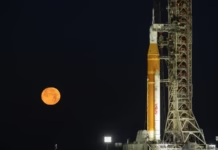

SpaceX on Wednesday filed for an IPO that Elon Musk says will bankroll an effort to show the rocket maker into an AI powerhouse, launching as much as 1 million data-center satellites into orbit to bypass energy and water limits on Earth.
Microsoft had an analogous ambition to flee land-based computing constraints in 2015, when it lowered a shipping-container-sized knowledge heart onto the seabed off Scotland, aiming to chop vitality use by pure seawater cooling and tapping offshore wind and tidal energy.
Microsoft’s “Venture Natick,” as soon as touted as a possible breakthrough for the data-center business, efficiently met all its technical targets however underwater knowledge facilities have been deserted greater than two years in the past because of a scarcity of shopper demand and unviable economics, two sources with data of the mission informed Reuters.
Requested for remark, a Microsoft spokesperson stated: “Whereas we don’t presently have datacenters within the water, we’ll proceed to make use of Venture Natick as a analysis platform to discover, check, and validate new ideas round datacenter reliability and sustainability.”
5 knowledge heart specialists informed Reuters that what went fallacious for Microsoft is a cautionary story for SpaceX as a result of though each tasks are a world aside geographically, they share key similarities: they each depend on modular items which might be costly to deploy and can’t be expanded, repaired or upgraded – options thought-about vital by the AI business.
“These issues are prone to be extra extreme in house than underneath the ocean,” stated Roy Chua, founding father of business analysis agency AvidThink, pointing to unresolved questions over easy methods to cool knowledge facilities in orbit, excessive rocket launch prices and the consequences of the cruel house setting on AI chips. SpaceX didn’t reply to a request for remark. SpaceX, which acquired Musk’s AI startup xAI in February, might elevate as much as $75 billion when it goes public, making it probably the biggest IPO in historical past. The holdings of xAI embrace social media firm X, previously Twitter, and AI chatbot Grok.
Musk’s house ambitions face hurdles
Though Microsoft proved that undersea knowledge facilities might work, clients weren’t fascinated with scaling them, as an alternative increasing standard land-based services that allowed cheaper, sooner upgrades as AI growth accelerated, the 2 individuals with data of the mission stated, asking to not be named as a result of sensitivity of the matter.
Story continues under this advert
The sealed, “locked-for-life” design – which SpaceX would replicate in orbit – has restricted flexibility, since AI chips are quickly enhancing yearly, whereas a satellite tv for pc or undersea knowledge heart is likely to be changed solely each 5 to seven years.
The economics have been additionally a stumbling block, the 2 individuals stated. Deploying knowledge facilities underneath the ocean was dearer than constructing on land, and whereas these prices might need fallen at scale, doing so would have required tens of billions of {dollars} in funding.
Area can be far dearer.
Analysts at MoffettNathanson, an impartial U.S. fairness analysis agency, stated in a February analysis observe that Musk’s plan to place 1,000,000 AI satellites in house would run into the trillions of {dollars}.
To ensure that knowledge facilities in house to change into commercially viable, launch prices would want to fall from right now’s low 1000’s of {dollars} per kilogram to the low tons of of {dollars} per kilogram, analysts say.
Story continues under this advert
“The downside is just not whether or not one thing can work, however whether or not it is smart economically versus merely constructing extra capability on the bottom,” stated Tim Farrar, an impartial satellite tv for pc business analyst at TMF Associates. Musk says he’ll overcome the technical and monetary hurdles, together with radiation publicity, warmth administration in a vacuum and the necessity for frequent {hardware} substitute, by sharply reducing launch prices and growing extra resilient AI chips.
Demand won’t be a problem, Musk says, as a result of Earth’s vitality sources will shortly be depleted as AI is required to help a world the place robots outnumber people, all automobiles drive themselves and house journey turns into routine.
“The concept that we simply can’t remedy issues on Earth, like energy shortages and environmental points, strikes me as unrealistically damaging about Earth to attempt to make every little thing appear higher in house,” Farrar stated.
Musk’s case hinges on Starship, SpaceX’s next-generation rocket, which is designed to be absolutely reusable and carry far bigger payloads than SpaceX’s Falcon rockets. However Starship is years delayed and has suffered explosive setbacks in a few of its 11 suborbital check flights since 2023.
Story continues under this advert
MoffettNathanson estimates that to realize Musk’s objective it might require 3,000 Starship launches a 12 months, or eight per day.
Jeff Bezos’ house firm Blue Origin can also be backing orbital knowledge facilities. The rocket firm stated in March that its Venture Dawn idea would add AI computing capability in orbit, tapping clear solar energy whereas preserving terrestrial data-center infrastructure.
Blue Origin didn’t reply to a request for additional remark.
Area AI could possibly be area of interest enterprise
Area knowledge facilities do have a future, however it’s extra prone to complement ground-based knowledge facilities, stated Claude Rousseau, a analysis director at Analysys Mason who tracks satellite tv for pc markets.
Story continues under this advert
“I strongly consider that there’ll be no means within the foreseeable future that space-based knowledge facilities can exchange floor knowledge facilities,” Rousseau stated, including that it might be a extra area of interest business serving infrastructure in orbit, like army satellite tv for pc constellations and house stations.
For example, the Worldwide Area Station already hosts experimental methods designed to course of knowledge in orbit and scale back reliance on downlink bandwidth.
Talking on the All-In podcast in February, Nvidia Chief Govt Jensen Huang stated the economics of space-based AI knowledge facilities stay unattractive.
“We should always undoubtedly work on the bottom first as a result of we’re already right here,” Huang stated, describing orbital AI infrastructure as a longer-term engineering problem fairly than a near-term answer.
Story continues under this advert
Chua stated schemes to maneuver knowledge facilities underneath the ocean or into house danger attempting to flee issues on Earth and creating an entire new set of more durable challenges.
“There are various issues that we are able to remedy on Earth earlier than house,” Chua stated, pointing to positive factors in AI chip effectivity, higher water recycling, and expanded use of solar energy and modular nuclear energy era.