
Orxa Mantis vs Ultraviolette F77 (2026)
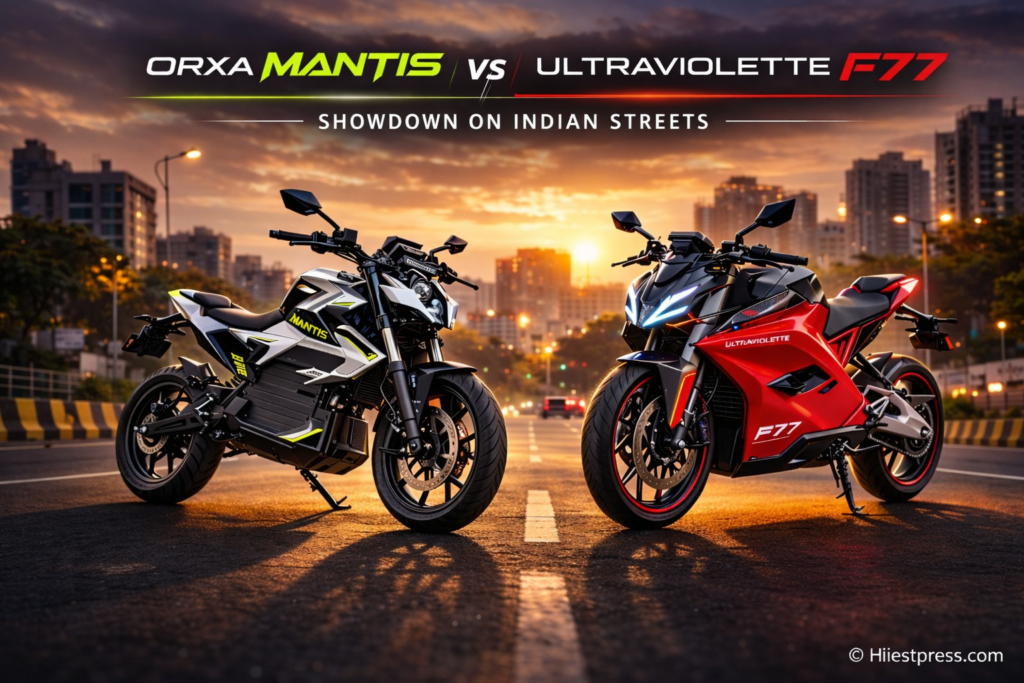
If you’re stuck between the Orxa Mantis and the Ultraviolette F77, you’re not alone. Both are made-in-India electric motorcycles, both look seriously good on paper, and both are aimed at the same kind of rider. But they’re not the same bike — not even close.
Here’s a straight-up breakdown so you can actually decide.
| 🔍 Specs | ⚡ Ultraviolette F77 | 🏍️ Orxa Mantis |
|---|---|---|
| Price (ex-showroom) | ₹2.99 – ₹3.99 Lakh | ₹3.60 Lakh |
| Range | Up to 211 km/charge | 221 km/charge |
| Top Speed | 155 km/h | 135 km/h |
| 0–100 km/h | 7.8 sec | 8.9 sec |
| User Rating | ⭐ 4.6 / 5 | ⭐ 4.4 / 5 |
About the Companies
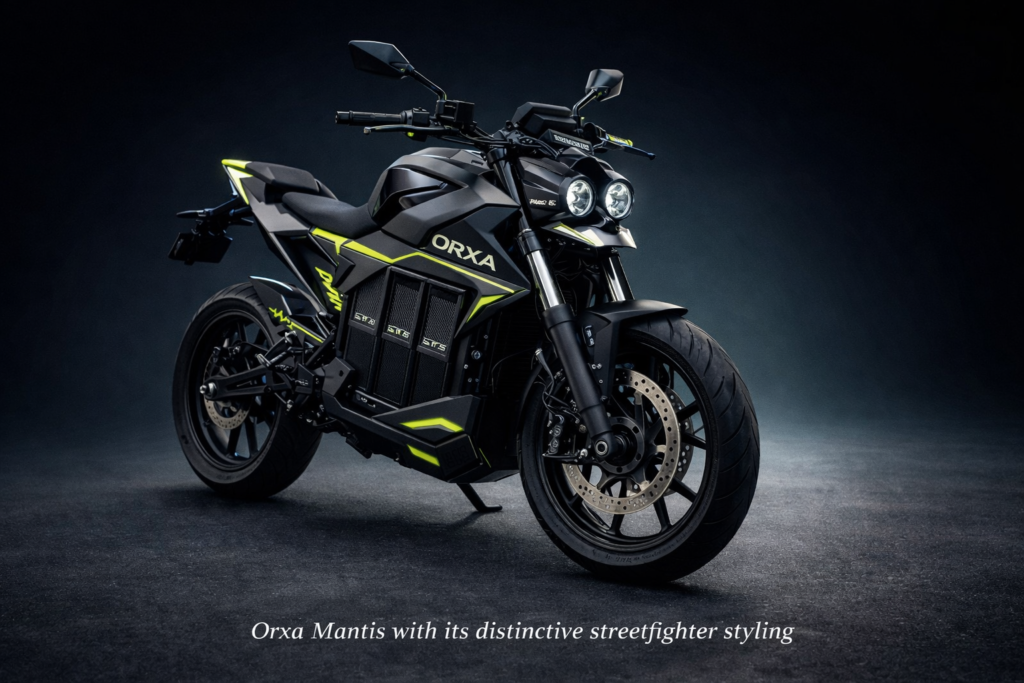
Orxa Energies was started in 2015 by two Bangalore engineers — Ranjita Ravi and Prajwal Sabnis — who simply couldn’t find a proper electric motorcycle in India. So they built one. Everything on the Mantis, from the motor to the battery management system to the operating system, was developed entirely in-house. In 2022 they rode prototype Mantis bikes 13,510 km across India in 54 days to prove the bike could handle real Indian roads. That kind of confidence in your own product says a lot.
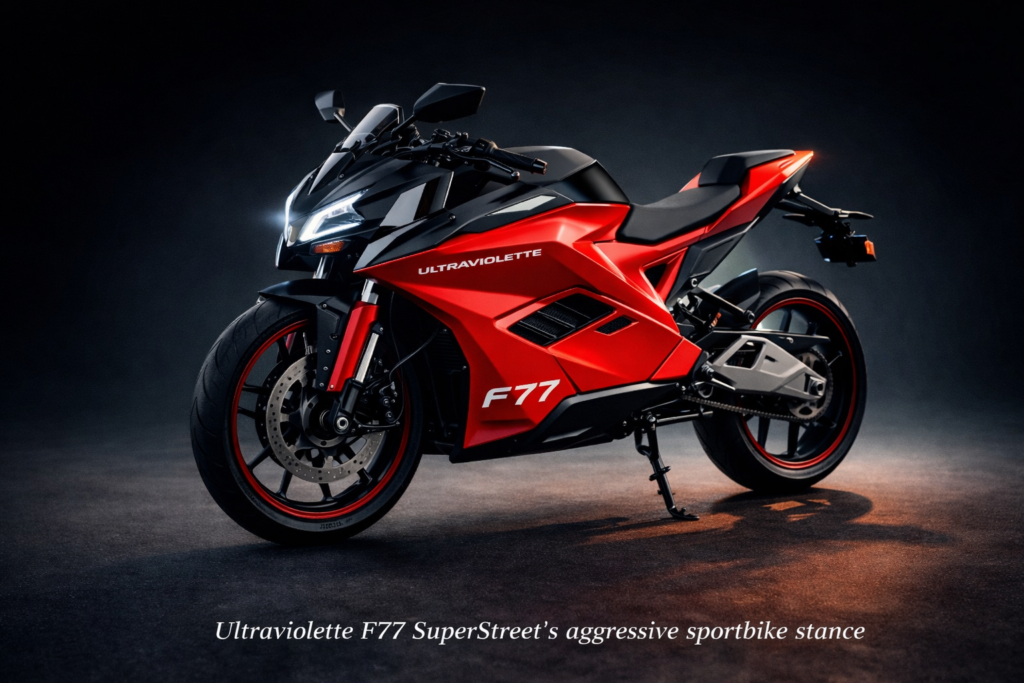
Ultraviolette Automotive was founded in 2016, also out of Bangalore, by childhood friends Narayan Subramaniam and Niraj Rajmohan. They’ve attracted serious money — TVS Motor Company, Zoho Corporation, and European investment firm Exor have all backed the startup, pushing its valuation to around ₹2,500 crore. In 2025, the F77 started being exported to 10 countries in Europe. That’s not something a struggling startup does.
| 🔍 Specification | ⚡ Ultraviolette F77 | 🏍️ Orxa Mantis |
|---|---|---|
| 💰 Price | ||
| Ex-showroom Price | ₹2.99 – ₹3.99 Lakh | ₹3.60 Lakh |
| On-road Price (Delhi) | ₹3.22 Lakh onwards | ₹3.83 Lakh |
| ⚙️ Motor & Performance | ||
| Motor Type | Permanent Magnet AC | BLDC |
| Peak Power | 27 kW (36 hp) ✅ | 20.5 kW (27 hp) |
| Torque | 90+ Nm | 93 Nm ✅ |
| Top Speed | 155 km/h ✅ | 135 km/h |
| 0–100 km/h | 7.8 sec ✅ | 8.9 sec |
| 🔋 Battery & Range | ||
| Battery Capacity | 7.1 kWh | 8.9 kWh ✅ |
| Claimed Range | 211 km | 221 km ✅ |
| Range (Eco Mode) | 183 km | 150 km |
| 🏗️ Build & Dimensions | ||
| Kerb Weight | 197 kg | 182 kg ✅ |
| Seat Height | 800 mm ✅ | 815 mm |
| Ground Clearance | 160 mm | 180 mm ✅ |
| Wheelbase | 1340 mm | 1450 mm |
| 🛞 Brakes & Suspension | ||
| Front Brake | 320 mm disc | 320 mm disc |
| Rear Brake | 230 mm disc | 230 mm disc |
| ABS | Dual-channel ✅ | Single-channel ❌ |
| Front Suspension | USD Forks ✅ | Telescopic Fork |
| 📱 Features & Tech | ||
| Riding Modes | Glide / Combat / Ballistic ✅ | — ❌ |
| Hill Hold | Yes ✅ | No ❌ |
| Park Assist | Yes ✅ | No ❌ |
| USB Charging Port | Yes ✅ | No ❌ |
| Navigation | No ❌ | Yes ✅ |
| Regenerative Braking | Yes ✅ | — ❌ |
| Mobile App | Yes ✅ | Yes ✅ |
| Colour Options | 9 colours ✅ | 1 colour ❌ |
Design and Riding Position
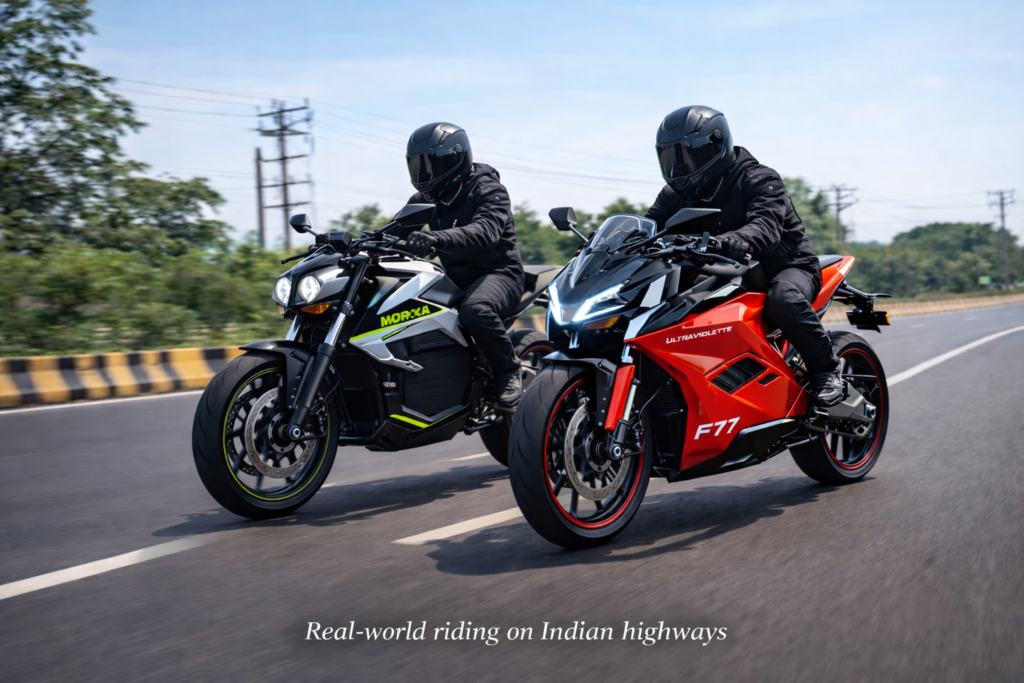
The Mantis is a naked streetfighter — raw, angular, looks like nothing else on Indian roads. The headlights literally look like a praying mantis staring you down. Riding position is upright and slightly rear-set, which makes city use comfortable. It’s lighter at 182 kg and has better ground clearance at 180 mm, so broken roads and speed bumps aren’t a concern.
The F77 is a fully-faired sportbike with aggressive lines and a low stance. The newer SuperStreet variants softened the ergonomics a bit — raised the bars, made it less committed — so it’s now doable as a daily ride without wrecking your back. It’s heavier at 197 kg but hides it well once you’re moving.
Style-wise — completely personal preference. The Mantis looks like a concept bike. The F77 looks like a proper sports bike. Neither looks bad.
Performance
The F77 is faster. That’s just the fact. 27 kW vs 20.5 kW, 155 km/h vs 135 km/h, and 7.8 seconds to 100 vs 8.9 seconds. The Ballistic riding mode on the F77 is genuinely addictive according to owners, and the handling with its wider rear tyre and more aggressive setup gives it an edge on twisty roads.
The Mantis is no slouch for city riding and regular highway use, but if you want to feel your face peel back at a traffic light, the F77 is the one.
One important safety point — the F77 has dual-channel ABS, the Mantis only has single-channel. On Indian roads where emergency stops happen constantly, that’s a real difference. Single-channel ABS means only the rear wheel is protected; the front can still lock up under panic braking.
Range and Battery
Interesting twist here — the Mantis actually has a bigger battery (8.9 kWh vs 7.1 kWh on base F77) and claims slightly more range at 221 km vs 211 km. In Eco mode though, the F77 Recon variants offer up to 323 km, which is in a different league.
Real-world riding? Both will give you somewhere between 130–170 km in mixed conditions. Enough for daily commuting without stress. For long highway rides, the higher-spec F77 Recon is a better choice.
Price — This is Where It Gets Interesting
The Mantis costs ₹3.60 lakh ex-showroom. One variant, one price.
The F77 starts at ₹2.99 lakh (base SuperStreet) and goes up to ₹3.99 lakh (Recon). That means you can get a more powerful, faster F77 with dual-channel ABS for ₹60,000 less than the Mantis. That’s hard to ignore.
The only way Mantis pricing makes sense is if you specifically want a naked bike with more ground clearance and you’re comparing it against the higher-spec F77 variants.
Pros and Cons
Ultraviolette F77
Pros
- More powerful motor (27 kW vs 20.5 kW)
- Higher top speed (155 km/h)
- Dual-channel ABS for safer braking
- Cheaper starting price (₹2.99 lakh)
- 9 color options
- Multiple riding modes
- Hill hold, park assist, USB charging
- Backed by TVS Motor and strong investor support
- Already being exported internationally
Cons
- Smaller base battery (7.1 kWh)
- Service center delays reported by several owners
- Software glitches reported across generations
- Heavier at 197 kg
- Lower ground clearance (160 mm)
Orxa Mantis
Pros
- Larger battery (8.9 kWh)
- Higher ground clearance (180 mm) — better for rough roads
- Lighter weight (182 kg)
- Unique naked street fighter design
- Fully in-house engineering including OS and BMS
- Belt drive means no chain maintenance
Cons
- More expensive (₹3.60 lakh) than base F77
- Single-channel ABS only
- Slower top speed and acceleration
- Only 1 color option
- Limited service network
- No riding modes, no hill hold, no USB port
Conclusion
For most people — the F77 is the smarter buy. It’s cheaper, faster, and safer. The dual-channel ABS alone is worth the switch. Add to that the riding modes, better feature list, and a company that’s clearly scaling up, and the F77 wins the value argument pretty comfortably.
That said, the Mantis has its own reasons to exist. If you genuinely prefer naked bikes, want more ground clearance for bad roads, don’t mind belt drive over chain, or just love the design — it’s not a bad bike at all. The in-house engineering is genuinely impressive for a startup this size.
But if you’re buying based on what gives you more for less money? Ultraviolette F77 SuperStreet at ₹2.99 lakh is the answer.